 Add to Chrome
 Add to Firefox
 Add to Edge
SCOPE: Simulating Cross-game Operations in Playable Environments for FPS World Models
May 28, 2026
Interactive world models for first-person shooter (FPS) games must resolve high-frequency overlapping control signals at every frame without disrupting unaffected regions. Existing methods inject actions globally and train on single titles, failing under dense FPS inputs. We observe that FPS actions are spatially selective: discrete events such as firing or reloading affect only a localized region around the weapon (the scope), while continuous camera and movement signals govern stable surroundings. We propose SCOPE, which inserts a conditioning module into each transformer block of a pretrained video diffusion model. It reshapes features into per-pixel temporal sequences so that each position computes its action response from local visual content. This separates in-scope effects from out-of-scope generation without segmentation labels. We also introduce CrossFPS, the first multi-game FPS dataset with frame-aligned action telemetry. It comprises 69K clips from 7 titles with 10-DoF controller signals, curated to remove gameplay bias. The model learns general visual-to-action mappings rather than game-specific patterns, enabling zero-shot transfer to unseen scenes. Experiments confirm strong action responsiveness, precise scope separation, and effective cross-game generalization.

Segment Anything with Robust Uncertainty-Accuracy Correlation
May 11, 2026Despite strong zero-shot performance, SAM is unreliable under domain shift due to Mask-level Confidence Confusion (MCC), where a single IoU-based mask score fails to reflect pixel-wise reliability near boundaries. Motivated by the contrast between texture-biased shortcuts in neural networks and shape-centric processing in human vision, we model out-of-domain variation as appearance shifts and non-rigid deformations that jointly stress calibration. We propose Segment Anything with Robust Uncertainty-Accuracy Correlation (RUAC) for robust pixel-wise uncertainty estimation under appearance and deformation shifts. RUAC adds a lightweight uncertainty head, trains it with a collaborative style-deformation attack that jointly perturbs texture and geometry, and applies Uncertainty-Accuracy Alignment to ensure uncertainty consistently highlights erroneous pixels even under adversarial perturbations. Across 23 zero-shot domains, RUAC improves segmentation quality and yields more faithful uncertainty with stronger uncertainty-accuracy correlation. Project page: https://github.com/HongyouZhou/ruac.git.
STS-Mixer: Spatio-Temporal-Spectral Mixer for 4D Point Cloud Video Understanding
Apr 13, 20264D point cloud videos capture rich spatial and temporal dynamics of scenes which possess unique values in various 4D understanding tasks. However, most existing methods work in the spatiotemporal domain where the underlying geometric characteristics of 4D point cloud videos are hard to capture, leading to degraded representation learning and understanding of 4D point cloud videos. We address the above challenge from a complementary spectral perspective. By transforming 4D point cloud videos into graph spectral signals, we can decompose them into multiple frequency bands each of which captures distinct geometric structures of point cloud videos. Our spectral analysis reveals that the decomposed low-frequency signals capture more coarse shapes while high-frequency signals encode more fine-grained geometry details. Building on these observations, we design Spatio-Temporal-Spectral Mixer (STS-Mixer), a unified framework that mixes spatial, temporal, and spectral representations of point cloud videos. STS-Mixer integrates multi-band delineated spectral signals with spatiotemporal information to capture rich geometries and temporal dynamics, while enabling fine-grained and holistic understanding of 4D point cloud videos. Extensive experiments show that STS-Mixer achieves superior performance consistently across multiple widely adopted benchmarks on both 3D action recognition and 4D semantic segmentation tasks. Code and models are available at https://github.com/Vegetebird/STS-Mixer.
StructKV: Preserving the Structural Skeleton for Scalable Long-Context Inference
Apr 08, 2026As Large Language Models (LLMs) scale to support context windows exceeding one million tokens, the linear growth of Key-Value (KV) cache imposes severe memory capacity and bandwidth bottlenecks, constraining the efficiency of long-context inference. Existing compression approaches typically prioritize tokens based on local saliency metrics to decouple prefill computation from decoding memory. However, these methods often rely on local saliency snapshots at a specific layer, thereby systematically discarding tokens that act as global information hubs across the network depth but appear temporarily dormant at the specific layer selected for pruning. To address this limitation, we propose StructKV, a structure-aware KV cache compression framework that introduces three core innovations: First, Global In-Degree Centrality aggregates attention patterns across the network depth to identify global information hubs. Second, Dynamic Pivot Detection utilizes information-theoretic metrics to adaptively locate the optimal layer for compression. Finally, Structural Propagation and Decoupling separates the computational budget from the memory storage budget. Experimental results on the LongBench and RULER benchmarks demonstrate that StructKV effectively preserves long-range dependencies and retrieval robustness.
L3DR: 3D-aware LiDAR Diffusion and Rectification
Feb 22, 2026Range-view (RV) based LiDAR diffusion has recently made huge strides towards 2D photo-realism. However, it neglects 3D geometry realism and often generates various RV artifacts such as depth bleeding and wavy surfaces. We design L3DR, a 3D-aware LiDAR Diffusion and Rectification framework that can regress and cancel RV artifacts in 3D space and restore local geometry accurately. Our theoretical and empirical analysis reveals that 3D models are inherently superior to 2D models in generating sharp and authentic boundaries. Leveraging such analysis, we design a 3D residual regression network that rectifies RV artifacts and achieves superb geometry realism by predicting point-level offsets in 3D space. On top of that, we design a Welsch Loss that helps focus on local geometry and ignore anomalous regions effectively. Extensive experiments over multiple benchmarks including KITTI, KITTI360, nuScenes and Waymo show that the proposed L3DR achieves state-of-the-art generation and superior geometry-realism consistently. In addition, L3DR is generally applicable to different LiDAR diffusion models with little computational overhead.
Direction-aware 3D Large Multimodal Models
Feb 22, 20263D large multimodal models (3D LMMs) rely heavily on ego poses for enabling directional question-answering and spatial reasoning. However, most existing point cloud benchmarks contain rich directional queries but lack the corresponding ego poses, making them inherently ill-posed in 3D large multimodal modelling. In this work, we redefine a new and rigorous paradigm that enables direction-aware 3D LMMs by identifying and supplementing ego poses into point cloud benchmarks and transforming the corresponding point cloud data according to the identified ego poses. We enable direction-aware 3D LMMs with two novel designs. The first is PoseRecover, a fully automatic pose recovery pipeline that matches questions with ego poses from RGB-D video extrinsics via object-frustum intersection and visibility check with Z-buffers. The second is PoseAlign that transforms the point cloud data to be aligned with the identified ego poses instead of either injecting ego poses into textual prompts or introducing pose-encoded features in the projection layers. Extensive experiments show that our designs yield consistent improvements across multiple 3D LMM backbones such as LL3DA, LL3DA-SONATA, Chat-Scene, and 3D-LLAVA, improving ScanRefer mIoU by 30.0% and Scan2Cap LLM-as-judge accuracy by 11.7%. In addition, our approach is simple, generic, and training-efficient, requiring only instruction tuning while establishing a strong baseline for direction-aware 3D-LMMs.
ZeroDiff++: Substantial Unseen Visual-semantic Correlation in Zero-shot Learning
Feb 12, 2026Zero-shot Learning (ZSL) enables classifiers to recognize classes unseen during training, commonly via generative two stage methods: (1) learn visual semantic correlations from seen classes; (2) synthesize unseen class features from semantics to train classifiers. In this paper, we identify spurious visual semantic correlations in existing generative ZSL worsened by scarce seen class samples and introduce two metrics to quantify spuriousness for seen and unseen classes. Furthermore, we point out a more critical bottleneck: existing unadaptive fully noised generators produce features disconnected from real test samples, which also leads to the spurious correlation. To enhance the visual-semantic correlations on both seen and unseen classes, we propose ZeroDiff++, a diffusion-based generative framework. In training, ZeroDiff++ uses (i) diffusion augmentation to produce diverse noised samples, (ii) supervised contrastive (SC) representations for instance level semantics, and (iii) multi view discriminators with Wasserstein mutual learning to assess generated features. At generation time, we introduce (iv) Diffusion-based Test time Adaptation (DiffTTA) to adapt the generator using pseudo label reconstruction, and (v) Diffusion-based Test time Generation (DiffGen) to trace the diffusion denoising path and produce partially synthesized features that connect real and generated data, and mitigates data scarcity further. Extensive experiments on three ZSL benchmarks demonstrate that ZeroDiff++ not only achieves significant improvements over existing ZSL methods but also maintains robust performance even with scarce training data. Code would be available.
Self-Consolidation for Self-Evolving Agents
Feb 02, 2026While large language model (LLM) agents have demonstrated impressive problem-solving capabilities, they typically operate as static systems, lacking the ability to evolve through lifelong interaction. Existing attempts to bridge this gap primarily rely on retrieving successful past trajectories as demonstrations. However, this paradigm faces two critical limitations. First, by focusing solely on success, agents overlook the rich pedagogical value embedded in failed attempts, preventing them from identifying and avoiding recurrent pitfalls. Second, continually accumulating textual experiences not only increases the time consumption during retrieval but also inevitably introduces noise and exhausts the largest context window of current LLMs. To address these challenges, we propose a novel self-evolving framework for LLM agents that introduces a complementary evolution mechanism: First, a contrastive reflection strategy is introduced to explicitly summarize error-prone patterns and capture reusable insights. Second, we propose a self-consolidation mechanism that distills non-parametric textual experience into compact learnable parameters. This enables the agent to internalize extensive historical experience directly into its latent space. Extensive experiments demonstrate the advantages of our method in long-term agent evolution.
Contrastive Graph Modeling for Cross-Domain Few-Shot Medical Image Segmentation
Dec 25, 2025Cross-domain few-shot medical image segmentation (CD-FSMIS) offers a promising and data-efficient solution for medical applications where annotations are severely scarce and multimodal analysis is required. However, existing methods typically filter out domain-specific information to improve generalization, which inadvertently limits cross-domain performance and degrades source-domain accuracy. To address this, we present Contrastive Graph Modeling (C-Graph), a framework that leverages the structural consistency of medical images as a reliable domain-transferable prior. We represent image features as graphs, with pixels as nodes and semantic affinities as edges. A Structural Prior Graph (SPG) layer is proposed to capture and transfer target-category node dependencies and enable global structure modeling through explicit node interactions. Building upon SPG layers, we introduce a Subgraph Matching Decoding (SMD) mechanism that exploits semantic relations among nodes to guide prediction. Furthermore, we design a Confusion-minimizing Node Contrast (CNC) loss to mitigate node ambiguity and subgraph heterogeneity by contrastively enhancing node discriminability in the graph space. Our method significantly outperforms prior CD-FSMIS approaches across multiple cross-domain benchmarks, achieving state-of-the-art performance while simultaneously preserving strong segmentation accuracy on the source domain.
Adversarial Robustness in Zero-Shot Learning:An Empirical Study on Class and Concept-Level Vulnerabilities
Dec 21, 2025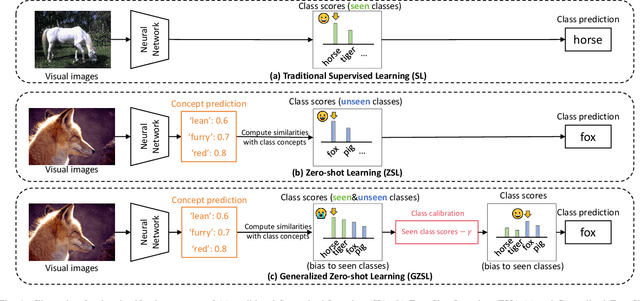
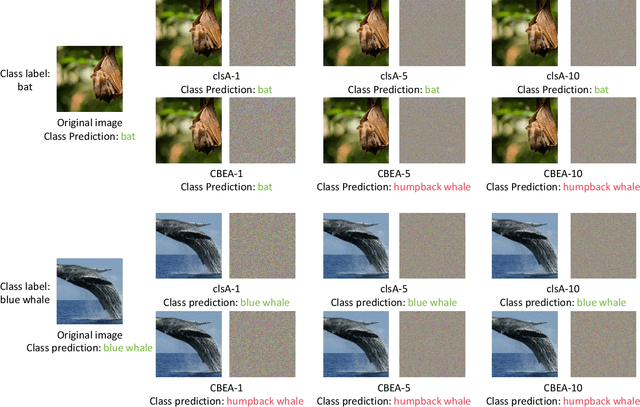
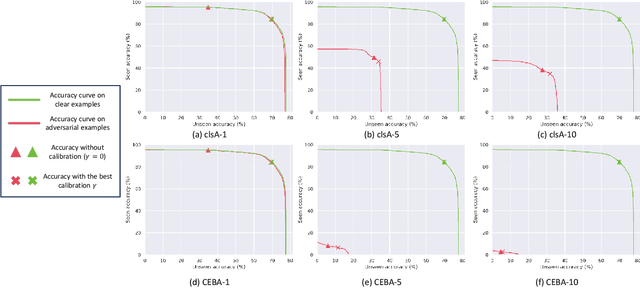
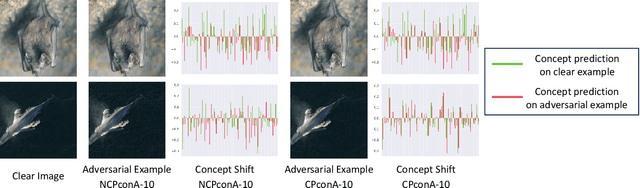
Zero-shot Learning (ZSL) aims to enable image classifiers to recognize images from unseen classes that were not included during training. Unlike traditional supervised classification, ZSL typically relies on learning a mapping from visual features to predefined, human-understandable class concepts. While ZSL models promise to improve generalization and interpretability, their robustness under systematic input perturbations remain unclear. In this study, we present an empirical analysis about the robustness of existing ZSL methods at both classlevel and concept-level. Specifically, we successfully disrupted their class prediction by the well-known non-target class attack (clsA). However, in the Generalized Zero-shot Learning (GZSL) setting, we observe that the success of clsA is only at the original best-calibrated point. After the attack, the optimal bestcalibration point shifts, and ZSL models maintain relatively strong performance at other calibration points, indicating that clsA results in a spurious attack success in the GZSL. To address this, we propose the Class-Bias Enhanced Attack (CBEA), which completely eliminates GZSL accuracy across all calibrated points by enhancing the gap between seen and unseen class probabilities.Next, at concept-level attack, we introduce two novel attack modes: Class-Preserving Concept Attack (CPconA) and NonClass-Preserving Concept Attack (NCPconA). Our extensive experiments evaluate three typical ZSL models across various architectures from the past three years and reveal that ZSL models are vulnerable not only to the traditional class attack but also to concept-based attacks. These attacks allow malicious actors to easily manipulate class predictions by erasing or introducing concepts. Our findings highlight a significant performance gap between existing approaches, emphasizing the need for improved adversarial robustness in current ZSL models.